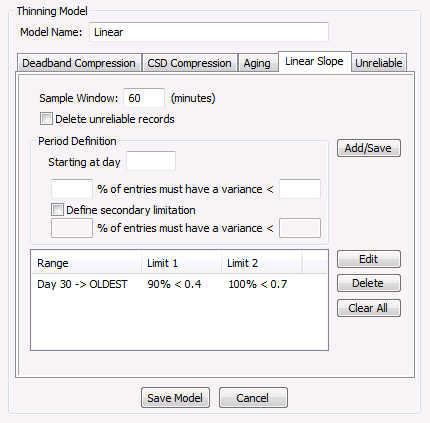
The linear slope model thins data by analyzing all the points in a time window and determining if they’re linear. If they are determined to be linear, then only the minimum and maximum values are saved. If the data is determined to be non linear, then none of the points are thinned. This model is optimum for series that have long periods of linear values with short bursts of change. With the right parameters specified, this model will only thin the long linear slopes and not touch the "interesting" data even if it has a partially linear component.
| Property | Description |
|---|---|
|
Sample Window |
Specifies the size of the time window (in minutes) for which a calculation is performed. The sample window should be roughly equal in size to the expected periods of "interesting" data. Each sample window is calculated from the beginning of the day so if your sample window is not evenly divisible by the number of minutes in a day, then the last sample window in each day will be smaller. |
|
Delete unreliable records |
If enabled, deletes all records that are marked as unreliable. Note: Only Analog point types marked as unreliable will be deleted. Use the Unreliable thinning model to delete all point types marked as unreliable. |
| Period Definition | |
|
Starting at day |
Specifies the number of days between today and timestamp of an entry. For example, a day value of 60 would correspond to all entries at least 60 days older than today. Must be a value greater than 0, no thinning can occur on entries from the current day. |
|
% of entries must have a variance < |
Specifies the percentage of points that must have a variance less than the specified limit. |
|
Define secondary limitation |
Click to enable a second limit. |
|
% of entries must have a variance < |
Specify the settings for the second limit. |
To Create a Linear Slope Thinning Model
To Edit a Linear Slope Thinning Model
|
|
| Sample Linear Slope Thinning Model |
In the example above, history values newer than 30 days would not be subject to thinning. All values older than 30 days would be evaluated in 60 minute windows. For each sample window, a best fit slope would be calculated using the points in the window. Then each point value is compared to the best fit slope and if at least 90% of the points have a variance less than 0.4 and all points have a variance of less than 0.7, then the data will be determined to be linear. The minimum and maximum values would be saved and then the next sample window would be evaluated.

|
|
|

